
PCI regulation forces you to build basic security walls, but it doesn't automatically stop hackers from climbing over them.
Year after year, businesses pass PCI compliance audits. They receive their certificates and assume their payment systems are secure. Yet, soon after, a data breach hits them.
This frustrating cycle repeats because passing an audit and stopping a cybercriminal are two different jobs. Auditors check your paperwork to ensure you meet the minimum baseline requirements. Hackers ignore the rules and hunt for the vulnerabilities your paperwork missed.
If you process credit cards, you face a tough balancing act. You must satisfy the regulators while also defending against real-world threats. To do this effectively, you must go beyond checklists and invest in active security testing that finds your blind spots before attackers do.
The Scope of PCI Regulations
It might surprise you, but the Payment Card Industry Data Security Standard (PCI DSS) is not a US government law.
The Standard was created in 2006 by major credit card brands like Visa, Mastercard, American Express, and JCB. These financial giants enforce the rules through their private contracts with merchants and service providers. If you want to accept card payments, your acquiring bank forces you to comply.
PCI regulation non-compliance isn’t a criminal offence, so you won’t be prosecuted or go to jail. However, you still face serious risks. Failure to comply can lead to:
- Severe fines
- Increased transaction fees
- Getting blocked from processing card payments
- Sued by card brands
- Being held liable for fraud losses if a breach traces back to you
The latest version, PCI DSS 4.0.1, offers more flexibility in how you meet the rules, but it also demands much deeper technical expertise to get things right.
Who Must Comply With These Rules
The answer is simple. Any company that stores, processes, or transmits cardholder data must follow PCI regulations.
This includes obvious targets like online stores and retail shops. But it also covers service providers who manage card data on behalf of other companies. If you run a payment gateway, provide cloud hosting, or sell software that handles financial transactions, you fall under this umbrella.
Your compliance level depends on your transaction volume. Big retailers processing over six million transactions a year face the strictest audits. Smaller merchants can often self-assess using standard forms.
However, processing fewer payments doesn't mean you face less risk. Hackers specifically target smaller companies because they expect to find weaker defences. Your paperwork burden might be lighter, but your security needs are identical.
The 12 Requirements That Shape Your PCI Compliance
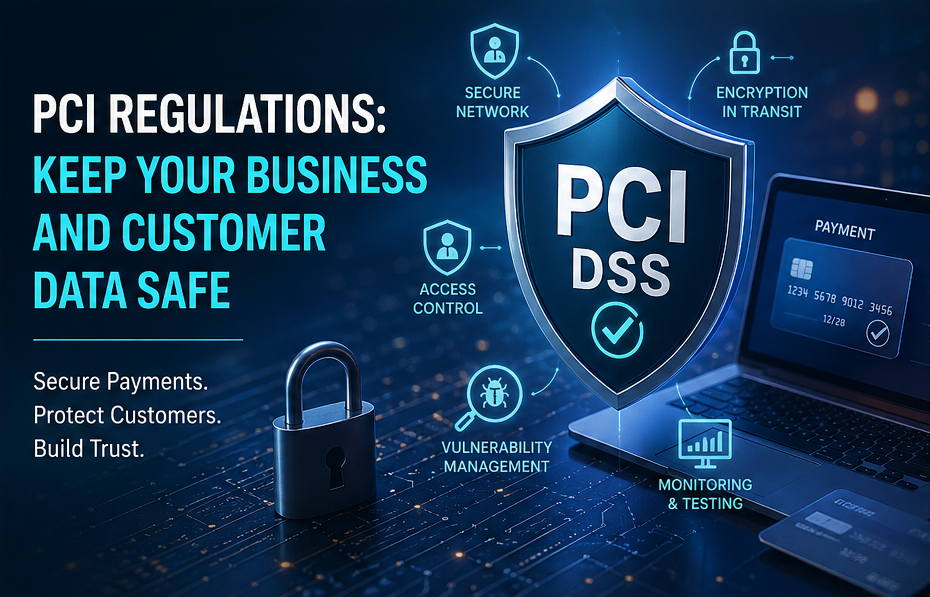
PCI DSS groups its rules into six main goals, broken down into 12 core requirements. You don't need to memorise it. Instead, understand how they work together to protect your data.
Goal 1: Build and maintain a secure network
- Requirement 1: Install and maintain network security controls.
- Requirement 2: Apply secure settings to all system parts.
Goal 2: Protect account data
- Requirement 3: Protect stored account data.
- Requirement 4: Protect cardholder data with strong encryption during transit.
Goal 3: Maintain a vulnerability management programme
- Requirement 5: Protect all systems from malicious software.
- Requirement 6: Develop and maintain secure systems and software.
Goal 4: Implement strong access controls
- Requirement 7: Restrict access to systems strictly by business need.
- Requirement 8: Identify users and confirm their access.
- Requirement 9: Restrict physical access to cardholder data.
Goal 5: Regularly monitor and test networks
- Requirement 10: Log and monitor all access to card data and systems.
- Requirement 11: Test the security of your systems and networks regularly.
Goal 6: Maintain an information security policy
- Requirement 12: Support security with clear company policies.
These requirements describe basic security habits, like network separation, encryption, access control, and testing. Yet, companies fail on these basics all the time.
Why? Because compliance checks only happen periodically, while security threats change daily. The 12 requirements create a basic safety floor. Attackers operate far above it.
The Trap of Passing Audits Without Real Security
Here’s a harsh reality that the payment industry rarely talks about: Several companies that suffered critical data leaks were fully PCI-compliant on the day they were hacked.
This happens because an audit is just a snapshot in time. It proves your controls worked on one specific day. It doesn't guarantee your firewalls will hold up when your staff changes settings or when you add new software.
Rules must be broad so they can apply to thousands of different companies. This broadness leaves room for interpretation and manipulation.
Consider Requirement 11, which demands regular security testing. Many companies meet this by running automated vulnerability scans.
These scanners catch basic issues and produce reports that keep auditors satisfied. But they miss business logic flaws, complex login bypasses, and chained attack paths. Automated tools can't think like a real hacker.
PCI Regulation and Penetration Testing: What the Standard Demands
Requirement 11.4 states you must perform penetration testing at least once a year and immediately after any major change to your network or apps. This testing must cover your network and application layers.
The new PCI DSS 4.0.1 rules make these requirements even stricter. Qualified internal staff or external experts must conduct these tests. Pentesting experts must use accepted industry methods, and they must test your defences both inside and outside your network.
The Grey Area
A test that just confirms your firewall blocks outside traffic doesn't meet the PCI DSS’s true intent. Effective testing must:
- Try to exploit vulnerabilities to reach your cardholder data.
- Test your network separation to prove that systems outside the payment zone can't reach the systems inside.
- Check if an attacker who hacks a minor server can pivot to steal more sensitive data.
When Your Business Needs Expert Pentesting Services
Beyond your annual compliance checks, you need proper manual testing to maintain compliance and real security.
You should book expert penetration testing services immediately:
- After deploying new payment software. Any app handling card data needs strict validation before it goes live to your customers.
- Following major network changes. Moving to new servers, adopting cloud services, or changing your network layout demands fresh testing.
- After finding a suspected breach. You must find out and fix what the hackers did and if any backdoors remain open.
- Before buying another company. Inherited computer systems often carry unknown flaws and compliance gaps.
- When upgrading core apps. New code needs thorough code audits to ensure developers didn't accidentally create new weak spots.
Build PCI Regulation Compliance That Actually Protects You
Find your data first
Many companies start by documenting what they think exists. But you must widen your search; card data easily leaks into unexpected places, like developer testing servers or legacy systems.
Before you protect the data, you must find exactly where it hides on your network.
Isolate your payment networks
Network isolation reduces your audit scope by separating your payment systems from everything else. Done well, it limits the damage if a hacker breaches a minor system, like your guest Wi-Fi.
Validating this isolation requires internal penetration testing to ensure hackers can't jump across the barrier.
Check your custom code
Requirement 6 demands secure development habits. If you build custom payment apps, secure development training helps your team write safer code. But training alone doesn't catch everything.
Comprehensive manual reviews catch the hidden flaws before they reach your customers.
Secure your cloud and AI tools
Modern payment setups use cloud servers and smart tools. Even if your provider secures the hardware, you remain responsible for the software configuration.
Regular cloud security audits ensure your remote servers meet the rules. If you use smart bots for customer service, AI penetration testing ensures they don't accidentally leak credit card numbers.
Frequently Asked Questions About PCI Regulations
Does PCI compliance protect me from legal liability?
Not completely. Compliance proves you met specific standards, which helps during talks with your bank after a breach. However, courts and regulators now expect companies to use reasonable security practices that go beyond minimum checklists. Compliance is the floor, not the ceiling.
Can I outsource my compliance to a payment processor?
You can reduce your scope by using a trusted third-party processor. However, you still retain responsibility for how card data enters and leaves your website. You also remain responsible for your physical office security.
What happens if I fail a PCI assessment?
You receive a report showing where you failed. You must then fix those gaps and prove compliance within a timeframe you negotiate with your bank. During this time, you might face higher transaction fees.
Does PCI regulation apply if we only take payments over the phone?
Yes. If your staff types card numbers into a computer, or if you record phone calls that contain spoken card details, those systems fall under the PCI regulations. You must secure those voice systems and networks just like a digital shopping cart.
Secure Your Payment Data Properly
The companies that handle PCI regulation best are the ones that stop treating it as a chore. They recognise that the PCI DSS simply describes sensible practices they should follow anyway.
When you adopt this mindset, testing becomes an opportunity to beat hackers to the punch.
At 7ASecurity, we help companies secure their systems through manual, expert testing. We don't just hand you a standard report; we offer a 100% quality guarantee and provide free verification to ensure your team fixed the issues correctly.