
P2PE vs E2EE compares two different encryption models. P2PE protects payment card data from the point of interaction to a secure decryption environment. E2EE protects content between communicating endpoints so intermediaries mustn’t read the plaintext.
One isn’t universally better. The right model depends on the data flow, endpoint trust, key handling, compliance context, and where plaintext appears during real use.
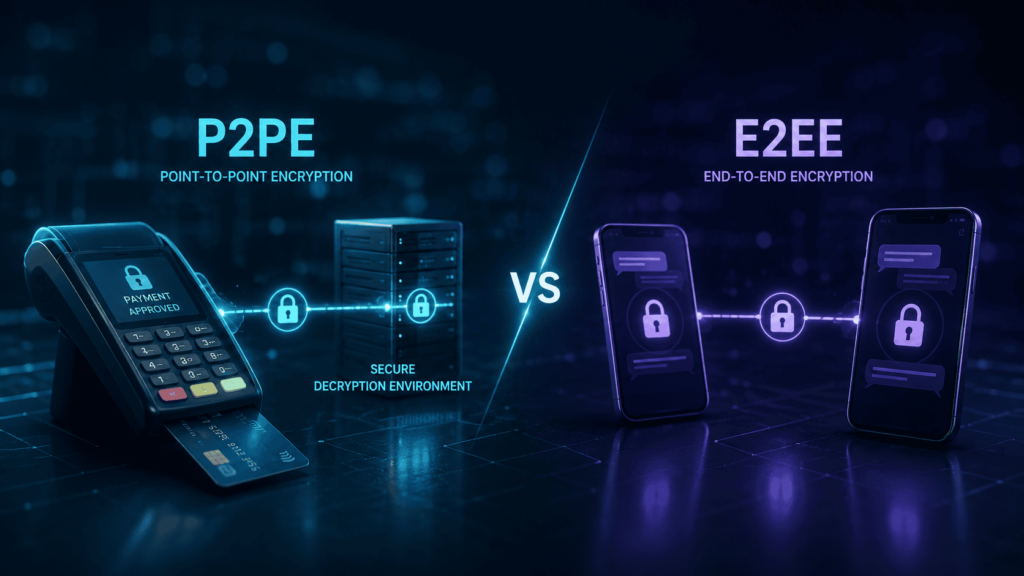
Encryption labels sound clean. Real systems aren’t.
A product can claim P2PE or E2EE and still leak sensitive data through logs, debugging tools, mobile storage, browser code, weak key handling, support workflows, or unclear decryption points.
The label tells you the intent. Testing tells you where the data actually goes.
That’s why penetration testing matters for encryption-heavy systems. You need to trace how data moves, where keys live, where plaintext appears, and what the application does when the happy path breaks.
7ASecurity’s researcher-led approach focuses on proving how systems behave in practice, not accepting labels at face value.
The Quick Difference
P2PE and E2EE solve different problems.
| Model | Main Use Case | Encryption Boundary | Who Should See Plaintext |
| P2PE | Payment card capture | From payment device capture to secure decryption environment | The secure decryption environment |
| E2EE | Communications or data exchange between endpoints | From sender endpoint to recipient endpoint | The intended endpoints |
PCI SSC describes P2PE as protecting payment account data from the point it’s captured in the merchant’s payment device to the point it’s decrypted in a solution or component provider’s environment.
Cloudflare describes E2EE as a model where a message appears in decrypted form only for the sender and recipient.
That distinction drives the whole comparison.
P2PE trusts a secure decryption environment. E2EE keeps the service path separate from the content plaintext path.
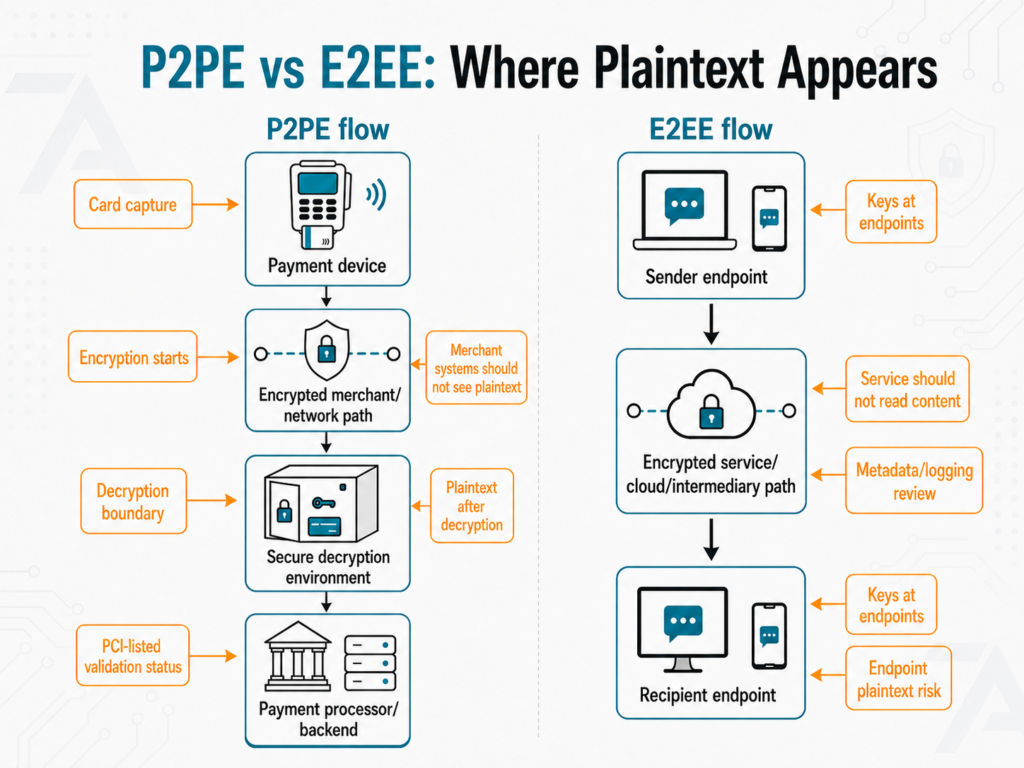
What P2PE Means in Practice
P2PE is built for payment flows.
The goal is to make cardholder data unreadable after capture, so merchant systems, networks, and connected services don’t handle clear-text payment data in the same way. P2PE makes account data unreadable until it reaches the secure decryption environment.
In a payment architecture, ask:
- Where is the card data captured?
- Is the device approved for that role?
- Where does encryption start?
- Where is decryption allowed?
- Which systems ever see clear-text card data?
- What gets logged by terminals, gateways, apps, and support tools?
- Who manages keys and device inventory?
PCI-listed P2PE solutions can reduce the number of applicable PCI DSS requirements for merchants. Merchant-managed P2PE arrangements need careful validation and shouldn’t be described as PCI-listed unless they appear on PCI SSC’s validated listings.
PCI SSC notes that a listed P2PE solution doesn’t completely remove PCI DSS applicability in the merchant environment.
In 2026, teams evaluating formal P2PE claims should also check the applicable PCI P2PE standard version and validation status.
- PCI SSC released P2PE Standard v3.2 in June 2025.
- New P2PE product submissions and reassessments must comply with v3.2 from 1 January 2026.
What E2EE Means in Practice
E2EE is common in messaging, collaboration, file sharing, mobile apps, and privacy-focused workflows.
Intermediaries shouldn’t read the content. The server may route, store, sync, or deliver encrypted data, but it shouldn’t hold the keys needed to decrypt message content.
TLS protects data in transit between a client and server. E2EE keeps the server out of the plaintext path. Cloudflare draws this line by contrasting end-to-end encryption with transport-layer encryption, where messages can be decrypted and re-encrypted while in transit through service infrastructure.
E2EE usually protects message content, but teams still need to review metadata such as sender, recipient, timestamps, device identifiers, file sizes, and routing information. Research on secure messaging notes that E2EE protects message content, while conversation metadata such as sender, recipient, and timing can remain exposed.
In an E2EE architecture, test these questions:
- Where are keys generated?
- Are private keys ever sent to the server?
- Where is plaintext rendered?
- What does the app cache locally?
- Do notifications, previews, logs, or crash reports expose content?
- How does account recovery work?
- What happens on linked devices?
- Can the server alter keys or downgrade security silently?
E2EE protects content confidentiality across the service path, so intermediaries mustn’t read the plaintext. TLS still matters for securing the connection itself.
Which Is More Secure, P2PE or E2EE?
That’s the wrong question to ask. Rather ask, “Which is more secure for what threat model?”
- Use P2PE when the core risk is payment card exposure between capture and authorised decryption.
- Use E2EE when the core risk is intermediary access to content between communicating endpoints.
Neither model fixes weak implementation.
- A P2PE flow still needs device security, key management, inventory control, secure decryption boundaries, and careful logging.
- An E2EE flow still needs safe endpoint storage, key verification, recovery design, metadata review, and protection against leaking plaintext through app features.
Encryption narrows the trust zone. It doesn’t remove trust.
Where Encryption Claims Fail
Look for the boring places; that’s where the leaks live. Logs, endpoints, support tools, and retries are where encryption claims often break down.
Plaintext Appears Earlier Than Expected
Data can be encrypted after it has been sent through a web form, a mobile screen, an SDK call, or a payment widget. That means the browser, mobile app, JavaScript, logs, analytics, or crash tools may see plaintext first.
Keys Live in the Wrong Place
Key generation, storage, rotation, revocation, recovery, backup, and device linking need documented design decisions.
OWASP’s cryptographic storage guidance points teams toward threat modelling, architecture review, and dedicated secret or key management systems where appropriate. Hardcoded keys, client-side secrets, shared test keys, weak rotation, and broad access to key material all turn strong cryptography into weak architecture.
Logs Tell the Truth Too Loudly
Sensitive data often leaks through debug logs, telemetry, support exports, analytics events, crash reports, and payment troubleshooting tools.
Logs don’t need to break encryption to cause damage. They bypass the intended boundary when they record plaintext, tokens, keys, identifiers, or sensitive metadata.
Endpoints Break the Promise
E2EE protects data between endpoints. It doesn’t stop a compromised endpoint from reading plaintext after decryption.
P2PE reduces exposure between capture and decryption, but the payment device and secure decryption environment still need protection.
The endpoint is where encryption ends. Treat it with respect.
What Teams Should Validate
A useful review maps the encryption boundary, not the brochure claim.
Check:
- The exact point where encryption starts.
- The exact point where decryption happens.
- Every system that sees plaintext.
- Who controls the keys.
- How keys are generated, stored, rotated, revoked, and recovered.
- What logs, analytics, and crash tools collect.
- Whether mobile or web clients cache sensitive data.
- How support teams access data.
- Whether third-party integrations receive plaintext.
- How failures, retries, and debugging behave.
This is where web application penetration testing and mobile app penetration testing help.
Runtime testing shows what the application exposes during real use. Source review shows whether the implementation matches the design.
Decision Guide: P2PE or E2EE?
| Question | P2PE Fit | E2EE Fit |
| Is the data payment card data captured at a payment device? | Strong fit | Usually not the main model |
| Should intermediaries be unable to read message or file content? | Not the main goal | Strong fit |
| Is PCI validation part of the decision? | Relevant for PCI-listed or properly assessed payment encryption | Not a PCI P2PE substitute |
| Are endpoints highly trusted and managed? | Important for POI and decryption systems | Critical |
| Is the server allowed to process plaintext? | At the secure decryption boundary | Usually no |
| Does the app need search, moderation, analytics, or support access? | Design-dependent | Harder without weakening the model |
The best choice is the model that matches the data flow and can be verified.
What a Good Finding Should Prove
A useful encryption finding needs more than “P2PE missing” or “E2EE claimed”.
It should prove:
- Which data is protected.
- Where encryption starts and ends.
- Which systems see plaintext.
- Who controls the keys.
- Whether logs or integrations leak sensitive data.
- Which endpoint assumptions are unsafe.
- Which fix changes the actual exposure.
The finding should make the boundary visible. Once the boundary is visible, teams can fix the weak point.
Know Where Your Encryption Boundary Really Ends?
Encryption claims are only useful when the boundary holds under real application behaviour.
7ASecurity can trace plaintext exposure, review key handling, and test web or mobile flows to show where sensitive data is protected and where it quietly reappears.
Let’s Discuss Your Security Scope
FAQs
Are P2PE and E2EE Interchangeable?
No. P2PE is mainly a model for protecting payment cards from the point of interaction to secure decryption. E2EE protects content between communicating endpoints, so intermediaries can’t read it.
Does P2PE Automatically Reduce PCI Scope?
No. PCI-listed P2PE, or a properly assessed arrangement confirmed by the relevant PCI stakeholders, can affect validation effort. It doesn’t automatically remove PCI DSS applicability.
Is E2EE Always More Secure Than P2PE?
No. E2EE is stronger for some privacy and communication threats. P2PE is designed for payment card capture and decryption boundaries. The right model depends on the data flow and threat model.
Can Logs Break P2PE or E2EE Protection?
Logs don’t usually break the encryption itself. They bypass its protection when they record plaintext, tokens, keys, identifiers, or sensitive metadata outside the intended boundary.
What Should Developers Test First?
Start by mapping plaintext. Find where data is created, encrypted, decrypted, logged, cached, exported, and displayed. Then review keys, endpoints, metadata, and third-party integrations.
Make the Encryption Boundary Prove Itself
P2PE vs E2EE is not a contest of acronyms. It’s a question of boundaries.
- Where does encryption start?
- Where does it end?
- Who has the keys?
- Which systems see plaintext?
- What do logs and support tools reveal?
We can review the code path, test the running web or mobile flow, and give your team a detailed, user-friendly plan to fix findings.