
Purple Team cybersecurity lets you move from uncertain system security to proven, real-world defence.
Consider this: Your company hires a penetration testing team. They spend two weeks testing your systems, recording flaws, and writing a technical report. That report lands on a manager's desk. Teams log the findings into a tracking system. They fix a few critical bugs, but most sit in a backlog. Six months later, a new testing team runs another audit. They find the same issues.
Your security operations centre (SOC) faces thousands of alerts and tunes their systems to detect known malware. Still, when a Red Team attacks, key signs are missed.
They didn’t miss the attack because they lack skills. They missed it because nobody showed them what a manual attack looks like in their network.
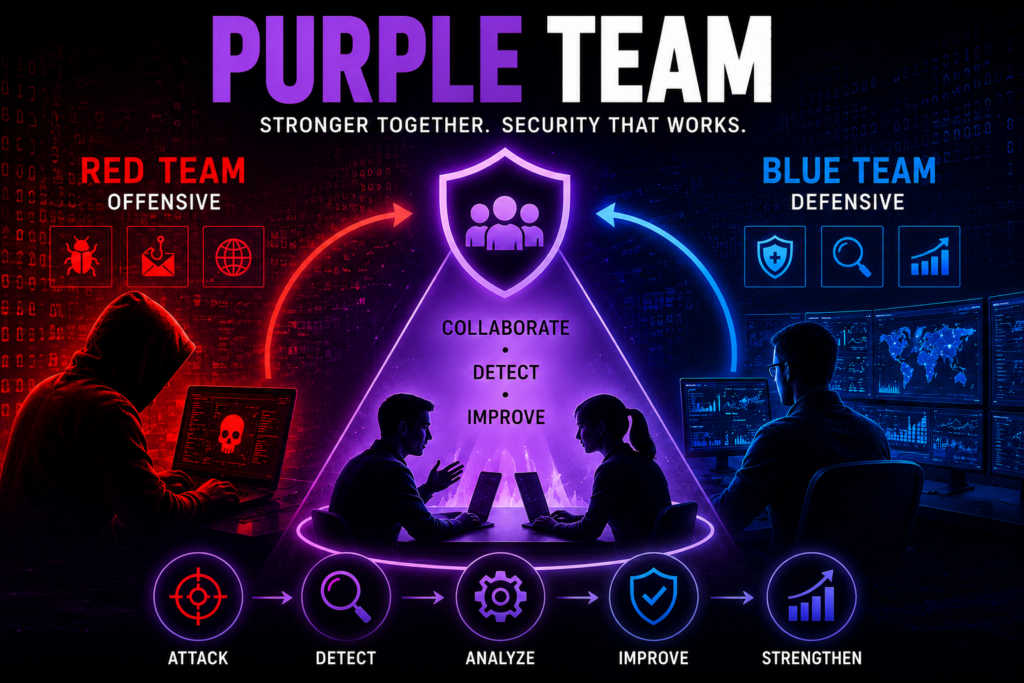
This gap is what Purple Team cybersecurity aims to close. Rather than being a new team to hire or software to buy, it’s a method that forces offensive (Red) and defensive (Blue) teams to work together, bridging the divide.
The Unfortunate Reality of Security Pentesting
The reality of life is that a standard security audit report alone can’t provide lasting safety.
Research shows that companies only remediate a small portion of the bugs testers find. In fact, median teams can fix only about 10% of the flaws they find each month. These teams patch the critical vulnerabilities. Yet they usually leave medium-level bugs in a queue and almost always ignore low-level issues. Over 82% of the vulnerabilities left in backlogs are medium and low severity.
Why does this happen? Tight budgets and complex old systems play a big role. Flaws are also found more quickly than they can be patched. But the biggest problem gets very little attention. Standard reports don't give your team the context they need to act.
A normal report might say, "SQL injection bug found in the search bar." This tells your IT staff what to patch, but it doesn't explain how the attack bypassed your firewalls. It doesn't tell them why your monitors stayed quiet.
Purple Team cybersecurity fixes this context gap.
When ethical attackers and defenders sit in the same room, every bug comes with clarity. Your team learns why your detections failed and how to respond. They don't get a list of chores, but they see where and how the network fell short.
This shared knowledge turns a basic compliance test into a cybersecurity upgrade.
The Problem With Keeping Red and Blue Teams Separate
The old security model treats attacking and defending as completely separate jobs. Red Teams attack. Blue Teams defend. They operate side by side, sometimes competing, but rarely talking.
This split made sense years ago. Security leaders wanted testers to act like real hackers, without inside knowledge, and defenders to prove they could spot threats without warning. The logic seemed sound: keep the simulation as real as possible.
But realism without feedback produces terrible results.
Think about what happens after a standard Red Team test. The offensive experts record their attack paths and the firewalls they bypassed. Management shares short summaries with the defending Blue Team. The defenders review the findings, sometimes only weeks later, without the context of how the attacks actually happened.
Important details are lost during this handoff. The Red Team might spend three hours bypassing a specific endpoint control. That information helps defenders understand exactly where their detection failed. Instead, the Blue Team receives a flat list of outcomes rather than a detailed map of the attacker's path.
How Purple Team Cybersecurity Actually Works
Purple Team cybersecurity is cooperative, where offensive testers and defensive engineers work together. They talk in real time during the security exercises.
The goal is never to "win" against the other side. The only goal is to identify exactly where your defences fail and fix those gaps right away.
For example:
A Red Team operator tries a targeted attack, like dumping passwords from a compromised computer. Instead of just noting if the attack worked, the Blue Team watches their detection systems at the same time.
- Did the SIEM fire an alert?
- Did endpoint detection flag the script?
- If not, why not?
When a defence fails, the experts investigate it together.
- Perhaps the logging setup missed a critical event.
- Maybe the detection rule was too narrow.
- Perhaps the alert triggered, but got lost under false alarms.
Whatever the root cause, the teams identify and fix it on the spot.
This fast feedback loop makes Purple Team cybersecurity incredibly valuable. Security flaws aren’t merely found; the teams understand them.
You can apply this method across multiple areas. Companies use these exercises to test web application security, strengthen internal network defences, and review cloud security configurations.
When Do You Need Purple Team Services
Not every company needs this level of teamwork right away. If you’re still building basic security controls, standard penetration testing provides the right starting value. However, certain situations demand a more integrated approach.
Here’s when you need these cooperative services:
- Your SOC struggles with alert fatigue. If your analysts see thousands of alerts daily and can’t spot real threats, cooperative testing helps tune your system to flag only what matters.
- You conduct routine audits without seeing improvements. Repeated testing that finds the same issues points to a learning gap. Purple Team cybersecurity ensures findings turn into actual network upgrades.
- You face sophisticated threats. Basic attackers might trigger simple alarms, but advanced threats won’t. You must prove your ability to stop hackers who actively adapt to your network.
- You need to prove detection capabilities for compliance. Frameworks like DORA and PCI DSS expect companies to show active detection, not just passive firewalls. These exercises provide evidence of your working defences.
You recently deployed expensive new security tools. New endpoint protection requires strict checks. You must verify that these investments actually work against real, manual attacks.
Frequently Asked Questions About Purple Team Cybersecurity
How long does a typical Purple Team test take?
The timeline depends on your scope. Focused exercises testing a few attack methods might take three days. Full engagements covering multiple threat scenarios often need two to four weeks.
Because the process includes real-time teamwork and quick fixes, you must plan for this in your schedule.
Do we need internal Red and Blue Teams to do this?
No. Companies without internal teams hire external specialists to provide both offensive and defensive skills. Working with external experts often yields better results. They bring exposure to new environments and attack methods that internal staff can miss.
How do you measure the success of Purple Teaming?
Effective measurement focuses on defensive improvement, not the total number of bugs found. Your key metrics should include:
- The time-to-detection for specific attacks.
- The percentage of attack phases spotted versus missed.
- The drop in your false positive alert rate.
What’s the difference between Purple Teaming and adversary simulation?
Adversary simulation focuses on copying a specific, known threat actor to test your readiness against their tactics.
Purple Teaming is a broader method focused on teamwork. A test might include adversary simulation, but the main feature is the real-time knowledge sharing between the attackers and the defenders.
Can this method apply to cloud environments?
Yes. Cloud setups introduce different attack angles, such as bad storage buckets and open access roles. Purple Team cybersecurity is effective for cloud security audits. It helps internal teams understand how hackers exploit these cloud-specific errors.
The 7ASecurity Advantage
Closing the gap between finding a flaw and stopping a real attack takes teamwork. Your engineering teams must learn from simulated breaches. They need offensive experts who understand defensive setups, alongside defenders who are eager to learn how hackers think.
At 7ASecurity, manual testing excellence forms the foundation of our work. Our researchers routinely find the critical bugs that automated scanners miss. We bring this manual focus to our Purple Teaming to help you turn simulated attacks into permanent cybersecurity upgrades that protect your revenue.
We also offer a 100% quality guarantee and free fix verification because your security spend should deliver real results, not just a PDF report.