
Compliance testing shows that your technical defences stop real cyberattacks and meet legal requirements. Smart teams integrate SOC 2, ISO 27001, DORA, and PCI DSS tests rather than running them separately. Mapping one manual, researcher-led security audit to your overlapping controls cuts duplicate costs. It uncovers real business logic flaws and gives auditors verified evidence they can approve right away.

Managing compliance testing across multiple cybersecurity frameworks can quickly feel like an endless loop of repeat audits, conflicting requests, and blown budgets.
When your calendar fills with separate test dates for SOC 2, ISO 27001, DORA, and PCI DSS, your engineers burn out. Every few months, you waste valuable sprint time describing your setup to various testing companies.
A security system should keep your business safe, not slow down your product.
The answer is simple. Group your technical security rules into a single test. By planning your scope upfront, you can meet several compliance regimes at once. You can solve this problem by booking tailored penetration testing services that check for real risks while ticking every audit box.
Why Auditors Demand Real Attack Simulation
Compliance rules use different words, but they all share a similar goal. They want proof that your security controls hold up against real attackers.
Many companies try to pass audits using automated scanner reports. That doesn't work well enough. Modern standards recognise that automated scanners, despite being highly sophisticated, only look for known software versions and missing patches.
They can't spot:
- Broken access controls that let users see each other's data.
- Flawed encryption setups that leak sensitive tokens.
- Logic bugs that let attackers bypass paywalls or multi-factor checks.
When external auditors look at your systems, they want to see human testing. They want to know if a skilled attacker can crack your login checks. They want to know if someone can jump from a public test server into your core database.
Auditors reject automated checklists because they value researcher-led security audits that really test your defences.
The 2026 Compliance Standards: What Each Framework Demands
Every framework looks at penetration testing through a slightly different lens. Knowing what each standard expects helps you plan one shared test.
1. SOC 2 Type 2 (Trust Services Criteria)
SOC 2 never says, "You must buy a penetration test." Yet, CPA auditors almost always ask for one. Auditors use your test report to verify key parts of the Trust Services Criteria.
- Common Criteria 6.1 & 6.6: Proving that firewalls and access controls block unauthorised traffic.
- Common Criteria 7.1: Proving that you find and fix system bugs quickly.
With a Type 2 report, your controls must be effective for the whole review period, which is usually between 6 and 12 months. If your test report shows open, unfixed flaws, auditors can delay your final sign-off.
2. ISO/IEC 27001:2022
The 2022 update of ISO 27001 brought stronger technical rules.
- Control A.8.8 requires companies to gather timely information about technical flaws, check their exposure, and fix them.
- Control A.8.29 requires security testing during development and acceptance.
Handing an auditor an automated scanner printout risks a non-conformity finding. Certification bodies want to see that you log flaws in a register, set clear fix deadlines, and test fixes to prove they worked.
3. EU DORA (Digital Operational Resilience Act)
In the EU, DORA is a big change for financial firms and important tech companies. Threat-Led Penetration Testing (TLPT) must be done by designated firms at least once every three years, according to Article 26 and the EU DORA technical standards.
TLPT isn't a simple check. It uses live threat intelligence to build realistic attack simulations. For these tests, live production systems that support important services are used. Because testing happens on live systems, teams must use strict safety rules to prevent downtime.
4. PCI DSS v4.0.1
The payment card industry sets some of the strictest rules in tech. Under PCI DSS testing rules (Requirement 11.4), firms handling card data must run:
- Cardholder data goes through annual internal and external penetration tests.
- More security audits should be conducted following any significant changes to the system or software.
- Network segmentation checks every six months for service providers to prove card data stays isolated.
Comparing Technical Testing Rules Across Standards
| Compliance Framework | Testing Status | How Often? | Main Focus |
|---|---|---|---|
| SOC 2 Type 2 | Standard CPA expectation | Annual (during audit window) | Web apps, cloud setups, and internal borders |
| ISO/IEC 27001:2022 | Required by Controls A.8.8 & A.8.29 | Annual or risk-based | Technical flaw management and dev/acceptance testing |
| EU DORA (Art. 24 & 26) | Legally binding in the EU | Annual testing (Art. 24) / 3-year TLPT (Art. 26) | Infrastructure resilience & threat-led live red teaming |
| PCI DSS v4.0.1 | Legally required by Rule 11.4 | Annual + after major changes | Cardholder Data Environment (CDE) & segmentation |
| GDPR (Article 32) | Legally required security measures | Regular and ongoing | Technical measures protecting personal data |
The Checkbox Trap: Why Scanners Fail Audits
Many businesses try to save time by buying scanner tools that promise effortless compliance. Automated scans are great for basic hygiene, but relying on them for audits creates big risks.
Scanners use pattern matching. They check if you run an outdated software version. But they can't link subtle flaws together like a human attacker does.
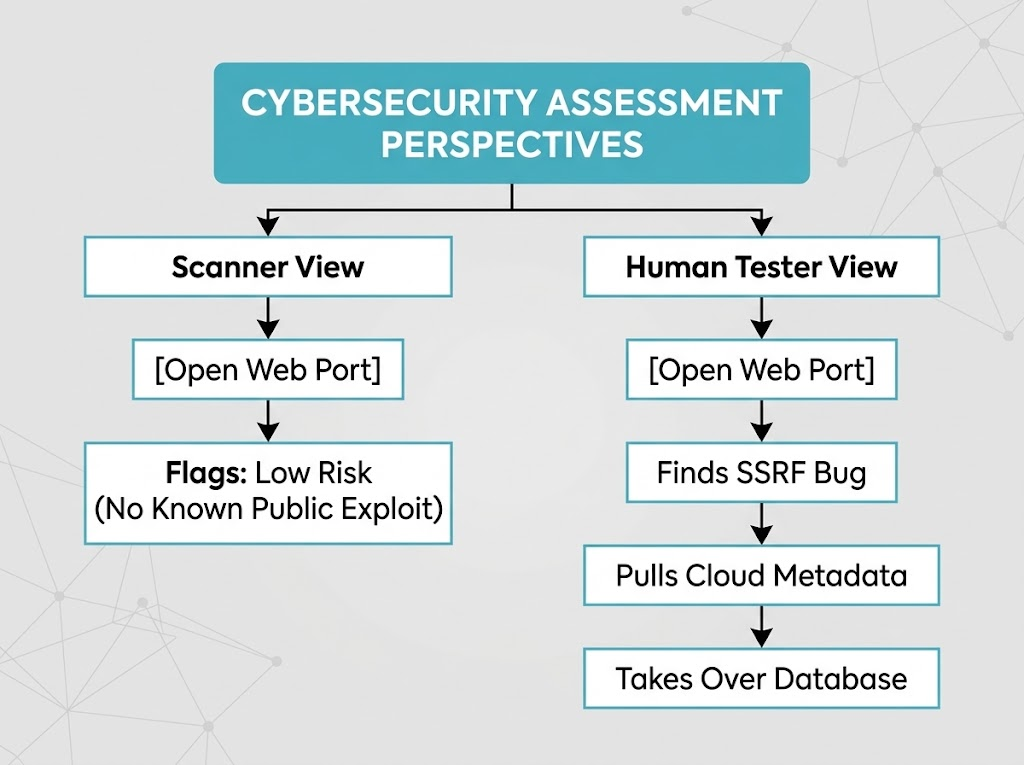
An automated tool might see an open web port and mark it as low risk.
A human tester digs deeper. They might find an unauthenticated server-side request forgery (SSRF) flaw. Using that bug, they pull internal cloud tokens and access your private database.
When an experienced auditor reviews your paperwork, they look for proof of exploitability. A 400-page scanner PDF packed with false alarms won't pass.
Our engineers carry out in-depth web application penetration tests to uncover broken access control and business logic bugs.
Harmonised Scoping: How to Meet Every Rule at Once
The best way to control compliance costs is through harmonised scoping. Instead of running four separate tests each year, you run one comprehensive engagement designed to meet every framework at the same time.
Here's how you set up a shared compliance test.
- Build One Combined Target List. Gather all your public IP addresses, domains, cloud setups, and core web APIs into one master scope. We map cloud boundaries and user rights during cloud security audits to meet several standards at once.
- Layer In Framework-Specific Checks. If you store card data, include PCI network segmentation tests. If you operate under EU financial rules, align your testing with DORA Article 24 operational resilience requirements so your annual evidence serves multiple auditors simultaneously.
- Draft Clear Rules of Engagement. Get a written document signed by all teams. Auditors ask for the document to confirm that testing was legal and agreed upon.
- Demand Verified Exploit Proof. Ensure your testing team notes the exact technical cause of every bug, along with reproduction steps and CVSS scores.
- Get Proof That Fixes Work. An audit report with open bugs creates compliance friction. Partner with a testing firm that retests your patches and issues an official retest attestation letter.
Combining your tests cuts down vendor paperwork, frees up your engineers, and gives your leadership one clear picture of your real security posture. It can also be more affordable to pay for one comprehensive penetration test instead of several smaller ones.
Simplify Your Compliance
Meeting multiple compliance standards doesn't have to drain your team. 7ASecurity runs researcher-led penetration tests that satisfy tough audit rules while finding real security flaws. Every test includes our 100% Quality Guarantee and Free Fix Verification Bonus. This gives you the retest proof auditors want to see.
Answers on Your Compliance Testing Questions
Can an Internal Security Team Conduct Compliance Testing, or Is a Third Party Required?
Some standards allow internal testing if the team is completely separate from daily IT operations. However, external auditors prefer independent third-party testers. Standards like PCI DSS v4.0.1 require third-party checks for specific merchant tiers. For SOC 2, CPAs look for unbiased third-party proof to avoid conflicts of interest. Hiring an outside team avoids audit delays.
How Do Auditors Treat Flaws Found on Staging Environments?
Auditors expect test environments to mirror production systems, code, and configurations. If testers find a vulnerability on a staging server, auditors will check if that same code runs on live systems. You must show whether live customer data was ever exposed. Before releasing the code to production, you must also show that your team retested the fix.
What Happens if We Make a Big Infrastructure Change Before the Audit’s Due?
Standards like PCI DSS v4.0.1 and ISO 27001 require testing after any major technical change, even if your annual audit is months away. Significant changes include moving servers to the cloud, rolling out a new login service, or releasing a new public API. Running a fast, targeted test on the new assets keeps your compliance standing intact.
How Does Continuous Testing Fit into Annual Compliance Audits?
Continuous testing checks your software across sprints rather than waiting for an annual deadline. For SOC 2 Type 2 reviews, this gives you solid evidence that your vulnerability tracking (CC7.1) worked throughout the entire year. It stops the last-minute scramble to patch bugs right before an auditor arrives.
Build Audit-Ready Security
Don't let conflicting compliance demands drain your engineering time. 7ASecurity delivers thorough, researcher-led penetration tests mapped directly to SOC 2, ISO 27001, DORA, and PCI DSS. Our audit-ready reports and verified retest attestation letters give auditors exactly what they need, so you can ship safer software.
Get Your Compliance Testing Plan
Want to Read More?
- See how offensive testing satisfies modern regulations across overlapping industry frameworks.
- Learn how to align ISO 27001 and SOC 2 into a unified audit roadmap that cuts duplicate spend.
- Check out our guide on building a DORA compliance roadmap to steer your firm toward true operational resilience.