
Penetration testing audit evidence must prove that your defences were tested and that your team fixed any discovered flaws. Auditors look for five core items: a signed Rules of Engagement agreement, clear scope boundaries, a detailed methodology, proof of verified exploitability, and an official retest attestation letter. Raw automated scanner outputs get rejected. You must show the full lifecycle from discovery to verified remediation.

Gathering solid penetration testing audit evidence is often the difference between a smooth compliance sign-off and a painful audit delay.
Every year, engineering leads assemble giant folders of files. They want to prove their systems are safe. Yet auditors often push back. They ask for more proof. They question testing limits. In extreme cases, they reject the evidence. That leads to audit findings.
Why does this happen? Most teams don't fail because their code is bad. They fail because their records are incomplete.
Auditors don't simply ask whether a test took place. They check how the team tested. They verify which servers were touched. Most of all, they need independent proof that you fixed every bug.
Auditors reject automated checklists because they value researcher-led security audits that test your real defences.
The Five Core Pieces of Audit-Ready Pentesting Evidence
When an external auditor opens your evidence folder, they look for five items. If one piece is missing, your evidence chain breaks.
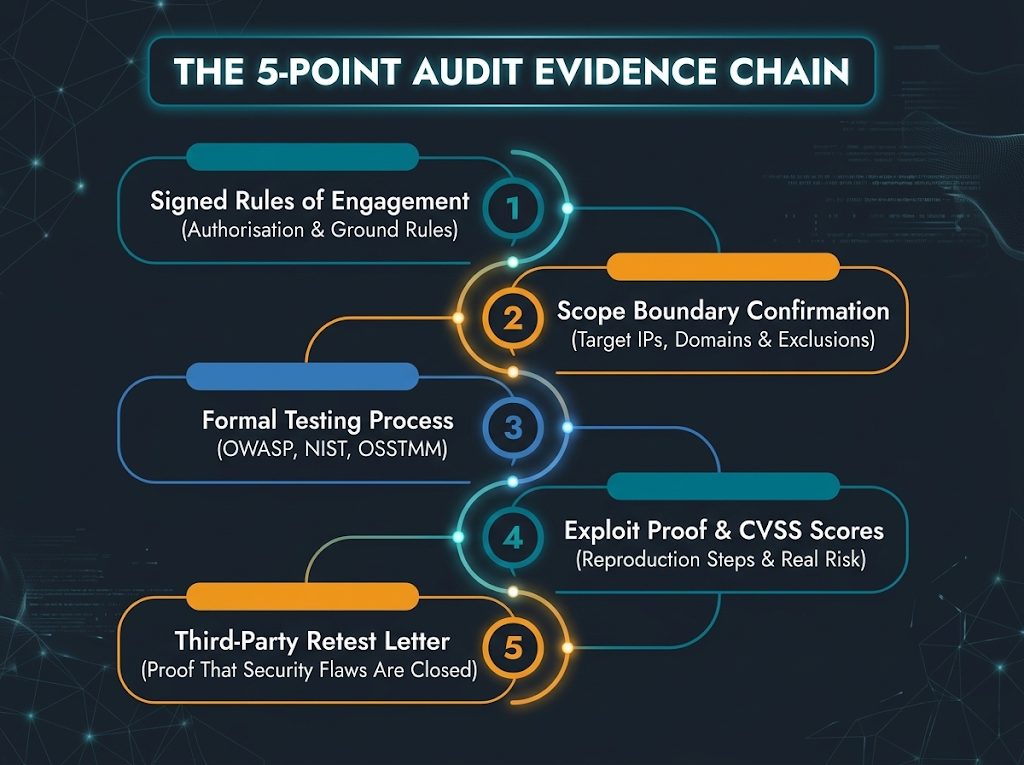
1. Signed Rules of Engagement (RoE)
Auditors must see that testing was legal and approved by leadership. Your RoE document must list:
- Legal company names for your firm and the testing partner.
- Exact dates when testing began and ended.
- Named contacts for emergency escalation.
- Safe testing rules for live production systems.
Without an RoE, auditors can't confirm that testing had formal management approval.
2. Clear Scope Records
Auditors check your pentest scope against your audit boundary. For example, if you audit a card environment for PCI DSS, the test must cover every system in that zone.
Your scope notes must show:
- Every IP address, domain name, API, and cloud tenant tested.
- Any systems left out, along with a written business reason.
- User roles and account tiers used during logged-in tests.
If an auditor sees that core databases or user portals were skipped, they'll ask for a fresh test.
3. An Established Testing Process
Auditors want to know how the tester worked. A report that lists bugs without explaining the process carries little weight.
Your evidence should state that testers followed recognised guides:
- OWASP WSTG for web application checks.
- NIST SP 800-115 testing rules for technical network tests.
- PTES for end-to-end attack paths.
Following an industry standard shows that testing was thorough and not random.
4. Verified Exploit Proof and CVSS Scores
Auditors don't accept theoretical bug reports. They need proof that an issue was confirmed on your systems.
Each finding in your report must provide:
- An industry-standard CVSS score (v3.1 or v4.0) with full vector metrics.
- Step-by-step reproduction steps.
- Screenshots or request logs showing how the flaw worked.
- A plain summary of potential business impact.
Our engineers run internal penetration testing services that map network boundaries and document attack chains. This report gives auditors the technical proof they expect.
5. Third-Party Retest Letter
This is the biggest hurdle in compliance audits today. Handing an auditor a report full of open bugs creates friction.
A complete evidence pack needs an official retest letter from your testing firm. This document must confirm:
- Original test dates and retest dates.
- A summary of all discovered bugs.
- Clear proof that the tester checked each fix and confirmed it works.
What Auditors Accept vs What They Reject
| Evidence Element | What Auditors Reject | What Auditors Accept |
|---|---|---|
| Testing Type | Automated scanner CSV exports | Manual, researcher-led penetration test reports |
| Scope Proof | Vague notes like "All systems tested" | Itemised lists of target IPs, domains, and web APIs |
| Fix Verification | An internal Jira ticket marked "Done" | A formal retest letter from an outside testing firm |
| Bug Severity | Arbitrary colours (Red, Yellow, Green) | Standard CVSS base scores with clear metrics |
| Timing | Reports delivered outside the audit window | Reports with dates matching the review period |
Why Unverified Vulnerabilities Stall Compliance Audits
Many technical teams make the same mistake during audit prep.
They finish a penetration test. The report lists six flaws. The team logs six Jira tickets. Developers patch the code and close the tickets. The compliance lead then shares the original pentest report along with Jira screenshots.
Auditors almost always reject this. Why? Because auditors can't just accept your word.
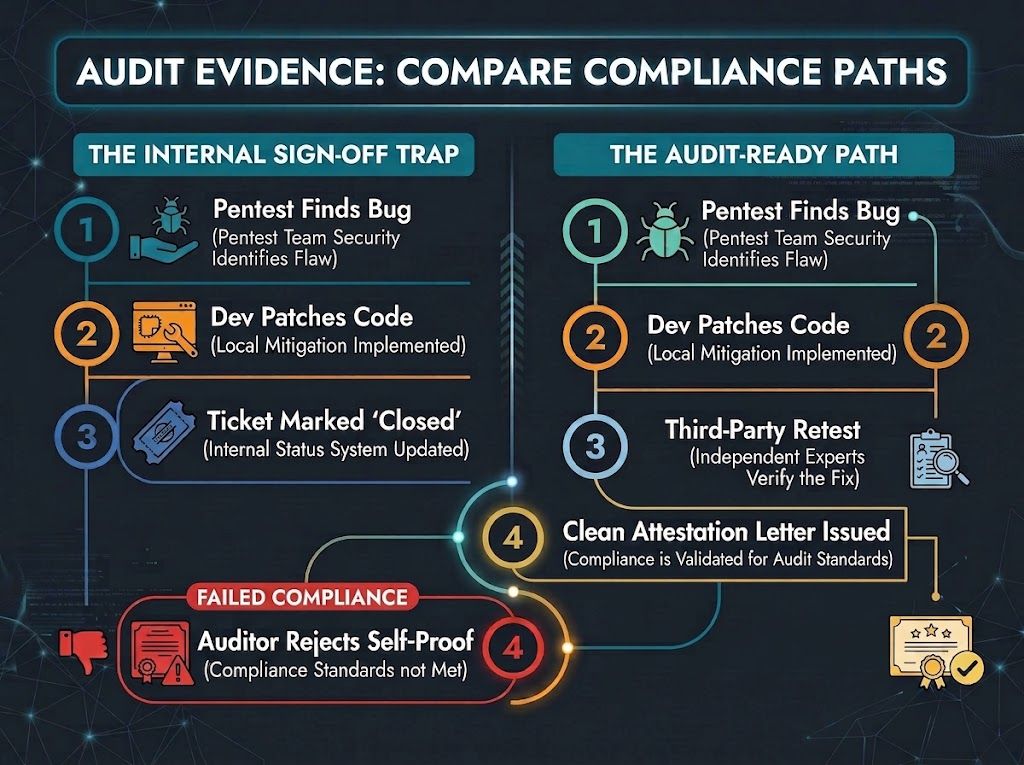
An auditor's job is to check that the controls are working. An internal ticket only shows that your team believes the bug is gone. It doesn't prove that the fix stops a real attack.
A rushed patch might miss an edge case. It might leave a secondary bypass open. It might fail to clean user input on all routes.
To meet rules like SOC 2 Type 2, ISO 27001, or PCI DSS, you need outside proof. At 7ASecurity, every project includes our Free Fix Verification Bonus. Once your team updates the code, our researchers retest your systems. We then issue an official retest attestation report at no extra cost
We also offer in-depth source code audits to verify that software fixes are secure at the code level.
Audit Evidence Anti-Patterns: Mistakes That Trigger Findings
Watch out for these four common evidence mistakes.
- Submitting Scans as Penetration Tests: Automated tools find missing patches. But they miss broken access controls and logic flaws. Experienced auditors can spot the difference immediately.
- Hiding Useful Context: You should mask live user data and production passwords. But don't hide URLs, test dates, or tester names. Auditors need those facts to confirm the report is real.
- Testing Too Late in the Audit Window: For SOC 2 reviews, test early in your review window. If you test in the final week, you run out of time to patch bugs and run a retest.
- Mismatched Version Dates: Keep your file versions clean. If your scope agreement says June but your test report says April, auditors will question the timeline.
Build Audit-Ready Security Evidence
Don't let weak paperwork derail your compliance goals. 7ASecurity delivers thorough, manual penetration tests built to satisfy external auditors. Every report includes clear methodology steps, verified exploit proof, and full retest notes.
Book Your Audit Scoping Review
Common Questions on Pentest Audit Evidence
How Do Auditors Treat Findings That Are Formally Accepted as Business Risk?
If you can't patch a bug right away, you can log formal risk acceptance. Auditors will check if your risk document includes written sign-off from an executive. They also look for a clear technical reason and temporary safeguards. Accepting risk is fine under rules like ISO 27001, as long as leadership formally reviews the choice.
How Should We Mask Sensitive Customer Data Before Sharing Reports?
Auditors follow strict non-disclosure rules, but masking user data is standard practice.You should redact customer records, credit card numbers, and production passwords from test logs. However, keep HTTP request paths, status codes, and code lines visible so auditors can evaluate the risk.
What Testing Cadence Do Auditors Expect for Rapid CI/CD Teams?
If your team ships code daily, an annual test is just a baseline. Auditors look at change logs to see how you check big architecture updates throughout the year. Sharing records from smaller, targeted audits alongside your annual test proves that your controls keep pace with rapid release cycles.
What Happens if a Retest Confirms That a Vulnerability Is Still Exploitable?
If a retest shows that a bug is still open, the tester can't issue a clean retest letter. When this happens, write down a remediation action plan. Detail your new fix milestones and temporary safeguards. Presenting a clear guide with agreed dates prevents major audit findings while your developers refactor the code.
Deliver Clear Proof to Your Auditors
Compliance audits don't have to be stressful. 7ASecurity gives you straightforward, researcher-led reports and verified retest certificates that satisfy auditors on the first pass. We help you avoid audit delays and build stronger defences.
Schedule Your Compliance Pentest
Want to Read More?
- See how to integrate pentest evidence into risk management so lead auditors sign off without delay.
- Learn how regular testing maintains SOC 2 compliance across your full twelve-month observation window.
- Review our actionable tips on PCI DSS vulnerability tracking to prove your remediation workflow meets auditor scrutiny.