
SOC 2 compliance proves that your business protects customer data over time. In a Type 2 audit, CPAs test whether your security controls worked across a 6- to 12-month window. While automated platforms track basic settings, auditors require independent penetration tests for Common Criteria CC6.1, CC6.6, and CC7.1. Handing auditors third-party exploit proof and verified retest records gives them the evidence they need to issue a clean report.

For any expanding tech company, reaching SOC 2 compliance is an essential milestone. Enterprise buyers ask for your report before signing deals. Security teams review it during vendor checks. Yet many engineering leads find the Type 2 audit process stressful.
The surprise often comes from the testing rules themselves. Many teams think that automated compliance apps handle everything. They link an agent to GitHub and AWS and assume every box is checked.
Then the CPA auditor arrives and they ask for your annual penetration test report.
Automated tools check basic settings, but they can't mimic a real hacker. To clear a Type 2 review, you must show that your defences can stop live attacks. Having supported dozens of successful SOC 2 Type II audits, we know exactly what evidence CPAs look for.
Understanding SOC 2: Type 1 vs Type 2 Audits
People often refer to getting a "SOC 2 certification". In reality, SOC 2 isn't a certificate. It's an independent report from a licensed CPA firm.
There are two kinds of reports.
- Type 1 Reports: A point-in-time check. The auditor verifies that your security controls are set up properly on a single day.
- Type 2 Reports: An operational check. Over a certain time period, usually 6 to 12 months, the auditor checks that your security controls worked properly.
Passing a Type 1 audit is simple. You write policies, turn on security settings, and share screenshots.
Passing a Type 2 audit takes more work. The auditor pulls sample records from throughout the year. They want to see that your controls never stopped working. This is where penetration testing evidence is essential.
How Penetration Testing Meets Trust Services Criteria
The American Institute of Certified Public Accountants (AICPA) builds SOC 2 around Trust Services Criteria.
There are three main areas where penetration testing is the most necessary proof.
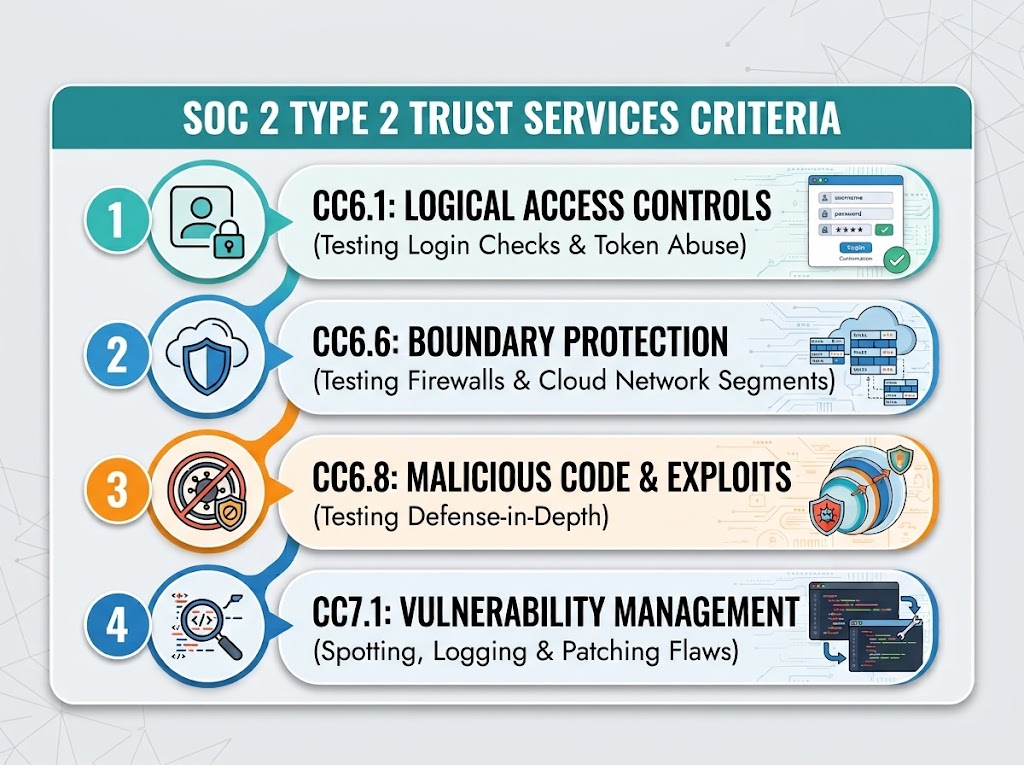
1. Common Criteria 6.1 and 6.6 (Access Control and Boundaries)
Auditors verify that outsiders and unauthorised users cannot access customer data. A penetration test evaluates these boundaries.
- Can an unauthenticated user access private APIs?
- Can a standard user tamper with parameters to view another client's data (IDOR/BOLA)?
- Do firewall and network rules prevent lateral movement into databases?
We run targeted cloud security audits to check that user rights and cloud perimeters hold up under review.
2. Common Criteria 6.8 (Stopping Exploits)
Auditors check that you protect your systems against unauthorised code execution and web bugs.
Our team carries out web application penetration tests to find broken login logic and data leaks. Showing that your apps block injection attacks and data tampering meets CC6.8 criteria.
3. Common Criteria 7.1 (Identifying and Managing Vulnerabilities)
This is where the AICPA explicitly calls for independent testing. Auditors review how you discover and handle software weaknesses.
- If an independent testing team evaluates your web apps, APIs, and cloud perimeter
- Whether your team logs all identified vulnerabilities with objective CVSS scores.
- Whether developers remediate high-risk findings within your policy SLAs.
- If an external tester independently retests the fixes.
The Automated Tool Myth: Why Software Alone Can't Pass
Compliance software is popular today. These tools help teams write policies and track laptops. However, some vendors claim their tool replaces human security testing. This isn't true.
Automated platforms check system settings. They can flag if an AWS S3 bucket is public. They can verify that staff turn on two-factor logins.
What they can't do:
- Test if an API leaks data due to broken user checks.
- Chain three small bugs together to take over a database.
- Mimic a malicious user trying to jump tenant boundaries.
CPA auditors understand this gap. If you hand over a dashboard screenshot instead of a test report, the auditor will flag an exception. Manual tests provide the human attack analysis that software can't match.
How to Handle Flaws Found During the Audit Window
Engineering leads often worry about finding bugs during a Type 2 review period. Many teams panic, assuming that finding a bug means failing the audit.
That's not how SOC 2 works. Finding flaws during a penetration test is normal. Auditors don't expect zero bugs. What auditors look for is your response.
- Log the Bug Right Away. Put the vulnerability in your issue tracker with its CVSS score.
- Follow Your Fix Deadlines. If your rule says to fix high-risk bugs in 14 days, meet that target.
- Get an Outside Retest. Once developers deploy the patch, have your testing partner retest it.
- Attach the Retest Letter. Hand the auditor the original report and the clean retest letter together.
This process gives auditors confidence in your cybersecurity practices and shows them that your vulnerability management process works in the real world.
Planning Your SOC 2 Testing Calendar
Timing your penetration test is vital during a Type 2 review. If you test too late, you run out of time to patch bugs. Testing too early can lead to your proof becoming outdated before the window closes.
Use these timing rules of thumb.
- Test in Month 3 or 4 of a 12-Month Window. This gives your team weeks to patch bugs and get a retest letter before the period closes.
- Test Significant Changes Right Away. If you launch a new user portal mid-year, test that tool immediately.
- Include Retesting In the Scope. Ensure your pentest quote includes retest verification so that you’re not left with unexpected costs or unmet expectations.
At 7ASecurity, every project includes our Free Fix Verification Bonus. We retest your fixes and issue an official letter so your auditors have proof.
Simplify Your SOC 2 Compliance Audit
Passing your SOC 2 audit shouldn't derail your sprint goals. 7ASecurity runs thorough penetration tests mapped directly to AICPA Trust Services Criteria. We give CPAs clear reproduction steps, technical evidence, and formal retest attestation letters that satisfy auditors every time.
Common Questions on SOC 2 Compliance Testing
What Happens if a Bug Fix Takes Longer Than Our Policy Allows?
If a fix misses your deadline, the auditor might note an exception in your report. An exception doesn't mean you fail. You can write a management response explaining the delay, noting temporary safeguards, and showing the completed retest. Clear notes prevent unexpected audit issues.
Can We Use Bug Bounty Reports as Proof for SOC 2?
Bug bounty reports show that people test your apps, but auditors rarely accept them as main proof. Bug bounties lack clear scope boundaries and formal testing steps. Auditors prefer a structured report showing that every system was checked systematically.
Does SOC 2 Require Testing Internal Networks or Only Cloud Apps?
It depends on which systems touch customer data. If your cloud stores client records, it must be in scope. If staff laptops connect to live databases or store private keys, auditors will expect internal network checks too.
How Many User Roles Should Testers Check in an App?
Auditors expect checks across all user tiers. This includes public visitors, standard users, and admins. Testing multiple roles proves that normal users can't raise their rights or view sensitive admin tools.
Achieve Painless SOC 2 Compliance
Don't let security testing hold back your growth. 7ASecurity delivers rigorous penetration tests designed to satisfy CPA auditors while uncovering critical technical flaws. Our audit-ready reports and verified retest attestation letters keep your compliance on track.
Want to Read More?
- Read why CPAs treat pentesting as an essential SOC 2 requirement before issuing a clean Type 2 report.
- Explore how penetration testing validates operational security against Common Criteria CC6 and CC7 controls.
- Follow our advice on how to streamline your SOC 2 Type 2 audit and avoid costly roadblocks.